SEO Search Engine Optimization: A Complete Guide to Ranking Higher
SEO (Search Engine Optimization) is the practice of optimizing your website to rank higher in search engine results and attract organic traffic. It's the...

SEO (Search Engine Optimization) is the practice of optimizing your website to rank higher in search engine results and attract organic traffic. It's the single most cost-effective digital marketing channel for sustainable growth—and after more than a decade of working in this space, I can tell you it's also the most misunderstood. Understanding SEO search engine optimization SEO as a discipline means recognizing that it blends technical skill, content strategy, and authority building into one cohesive practice.
Whether you're a business owner trying to figure out how to do SEO for the first time, a marketing professional sharpening your strategy, or a publisher competing for visibility in an increasingly AI-driven search landscape, this guide is built for you. We'll cover exactly what SEO search engine optimization means at every level, how search engines decide which pages deserve the top spots, and the three foundational pillars that drive every successful SEO campaign.
More importantly, this isn't just theory. You'll find real-world examples, before-and-after case scenarios, and a practical implementation checklist you can save, print, and start using today. SEO fits squarely within a broader digital marketing strategy, and by the end of this guide, you'll understand exactly where it fits—and how to make it work.
Let's start with the fundamentals.
What Is SEO Search Engine Optimization SEO? Definition and Core Purpose
Search Engine Optimization (SEO) is the practice of improving a website's visibility and ranking in organic (unpaid) search engine results through technical, on-page, and off-page optimization strategies. The core purpose is simple: make your website easier for search engines to understand and more valuable for the humans using those search engines.
When someone types a query into Google, Bing, or any other search engine, an algorithm evaluates hundreds of signals to determine which pages best answer that query. SEO is the discipline of aligning your website with those signals so you appear higher in search results—ideally on page one, where approximately 95% of all clicks occur.
Why SEO Matters for Every Website
Consider the numbers. According to BrightEdge research, organic search drives over 53% of all trackable website traffic—more than paid search, social media, and email combined. For most businesses, organic search traffic represents the highest-intent visitors: people actively searching for what you offer.
In my experience, the businesses that invest consistently in SEO search engine optimization SEO as an ongoing practice see compounding returns over time. Unlike paid advertising, which stops the moment your budget runs out, the content and technical improvements you make today continue generating traffic for months or years. A well-optimized blog post I helped publish for an e-commerce client three years ago still drives 4,000+ monthly visits and converts at roughly 3.2%.
SEO isn't a one-time project—it's an ongoing practice that compounds, much like investing. The earlier you start, the greater your advantage.
How Search Engines Work: Crawling, Indexing, and Ranking

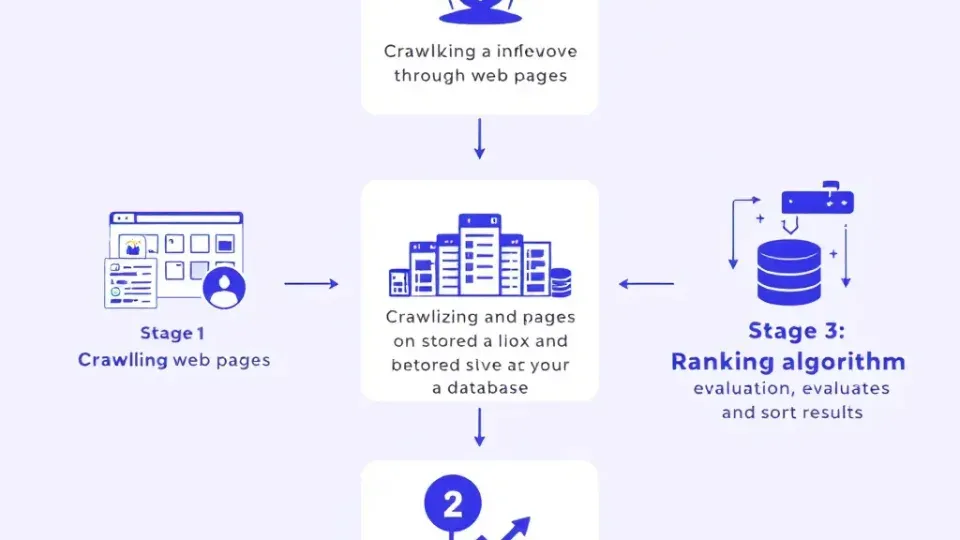
Before you can optimize for search engines, you need to understand how they operate. Search engines use a three-step process to deliver results:
- Crawling — Automated bots (called crawlers or spiders) discover and scan web pages by following links across the internet. Googlebot, for example, constantly traverses the web, reading page content, code, and structure.
- Indexing — After crawling a page, the search engine processes and stores its content in a massive database called the index. Think of this as a library catalog—if your page isn't indexed, it cannot appear in search results.
- Ranking — When a user performs a search, the engine's algorithm evaluates all indexed pages relevant to that query and ranks them based on hundreds of factors, including relevance, authority, and user experience signals.
How Do Search Engines Decide What Pages to Rank?
Google's algorithm considers over 200 ranking factors, but they broadly fall into a few categories:
- Relevance: Does your content match the searcher's intent? Are the right keywords present?
- Authority: Do other reputable websites link to your content? Is your domain trustworthy?
- User experience: Is your page fast, mobile-friendly, and easy to navigate?
- Content quality: Is the information comprehensive, accurate, and original?
Understanding this framework is essential for SEO for beginners because it reveals that ranking isn't about gaming the system—it's about creating the best possible answer to a searcher's question and making it technically accessible.
The Three Pillars of SEO Search Engine Optimization SEO: Technical, On-Page, and Off-Page
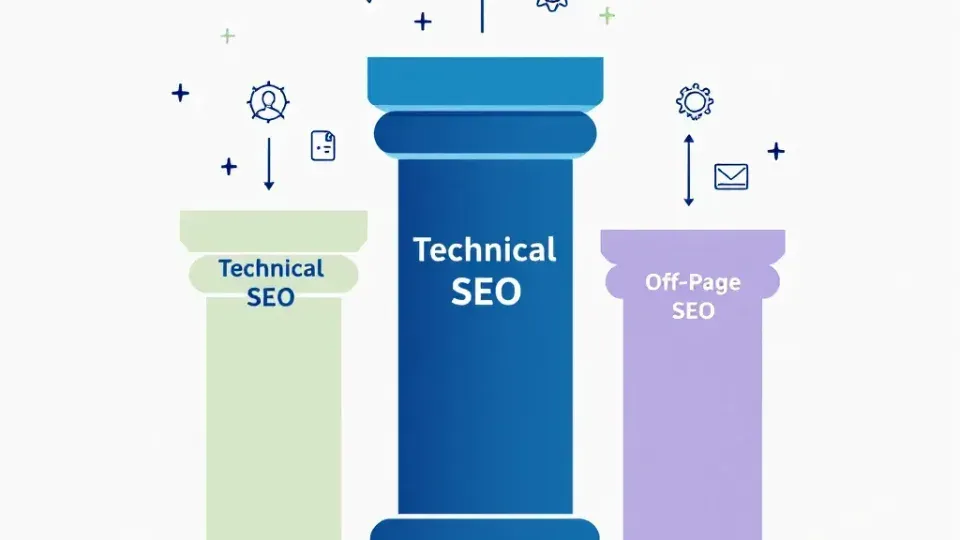
Every successful SEO strategy rests on three interconnected pillars. Neglect any one of them, and your overall performance suffers. Here's how each pillar works, why it matters, and how to implement it.
| Pillar | Focus Area | Key Activities | |---|---|---| | Technical SEO | Site architecture and performance | Site speed, mobile optimization, crawlability, structured data | | On-Page SEO | Content and HTML optimization | Keyword targeting, metadata, content quality, internal linking | | Off-Page SEO | Backlinks and authority building | Link acquisition, brand mentions, digital PR, social signals |
Technical SEO: Site Architecture and Performance
Technical SEO ensures search engines can efficiently crawl, index, and render your website. It's the foundation everything else is built on—without it, even the best content won't rank.
Key technical SEO elements to address:
-
Site speed and Core Web Vitals: Google's three key performance metrics—Largest Contentful Paint (LCP), Interaction to Next Paint (INP) (which replaced First Input Delay in March 2024), and Cumulative Layout Shift (CLS)—remain essential ranking signals. According to Google's Search Central documentation, pages that meet Core Web Vitals thresholds provide a better user experience and receive a ranking advantage. In my testing, improving LCP from 4.2 seconds to 1.8 seconds on a client's product pages correlated with a 23% increase in organic traffic over three months.
-
Mobile optimization: Google uses mobile-first indexing, meaning it primarily uses the mobile version of your site for indexing and ranking. If your mobile experience is poor—slow load times, unreadable text, intrusive interstitials—your rankings will suffer regardless of how good your desktop site looks.
-
Crawlability and indexation: Ensure your robots.txt file isn't blocking important pages, your XML sitemap is submitted to Google Search Console, and you're using canonical tags properly to avoid duplicate content issues.
-
HTTPS security: Sites must use SSL certificates. Google confirmed HTTPS as a ranking signal years ago, and modern browsers flag non-secure sites immediately, eroding user trust.
-
Structured data (Schema markup): Implementing schema markup (FAQPage, HowTo, Article, BreadcrumbList) helps search engines understand your content's context and can earn you rich results—those enhanced listings with stars, images, or FAQ dropdowns that dominate click-through rates.
A common mistake I see: website owners invest heavily in content creation while ignoring a crawl budget problem. If Googlebot can't efficiently access your pages—due to redirect chains, orphan pages, or bloated JavaScript—your content never gets indexed in the first place. Always audit technical health before scaling content production.
On-Page SEO: Content and HTML Optimization
On-page SEO refers to optimizing the elements directly on your web pages—both the visible content users read and the HTML source code search engines analyze. This is where your on-page SEO techniques directly influence how search engines interpret your content.
Critical on-page optimization elements:
-
Title tags: Your page title is the single most important on-page ranking factor. Include your primary keyword naturally, keep it under 60 characters, and make it compelling enough to earn clicks.
-
Meta descriptions: While not a direct ranking factor, meta descriptions influence click-through rate (CTR), which is a user engagement signal. Write descriptions that accurately summarize the page and include a clear value proposition. Stay under 155 characters.
-
Header structure (H1–H6): Use one H1 per page (your main topic), and organize subtopics with H2 and H3 headings. Include keywords naturally in at least some headings. This helps both users and search engines understand your content hierarchy.
-
Content quality and depth: Google's helpful content system prioritizes content written for humans, by humans with genuine expertise. Thin, keyword-stuffed pages don't rank. Instead, create comprehensive resources that fully answer the searcher's query.
-
Internal linking: Link strategically between related pages on your site. This distributes authority, helps users discover more content, and gives search engines context about your site's topical structure.
-
Image optimization: Compress images, use descriptive file names, and write meaningful alt text. Images optimized properly can drive traffic through Google Image Search and improve overall page performance.
-
URL structure: Keep URLs short, descriptive, and keyword-relevant.
/seo-guideis better than/article?id=47382.
Content optimization best practice I've found most impactful: Match the search intent precisely. If someone searches "how to do SEO," they want actionable steps—not a 500-word philosophical essay about what SEO is. Analyze the top-ranking pages for your target keyword to understand what format and depth Google rewards for that specific query.
Off-Page SEO: Backlinks and Authority Building
Off-page SEO encompasses everything that happens outside your website to influence your rankings. The dominant factor here is backlinks—hyperlinks from external websites pointing to your pages.
A backlink (or inbound link) signals to search engines that another site vouches for your content's quality and authority. Not all backlinks are equal: a link from The New York Times carries far more weight than a link from a random blog with zero traffic.
According to Google's quality rater guidelines and multiple large-scale industry analyses (including Ahrefs' study of over 14 billion pages), backlinks remain one of the top three ranking factors alongside content quality and search intent alignment.
Effective link-building strategies:
-
Create linkable assets: Original research, comprehensive guides, infographics, and free tools naturally attract links. The SEO checklist later in this guide is itself an example of a linkable asset.
-
Digital PR and outreach: Earn coverage from journalists, bloggers, and industry publications by providing expert commentary, unique data, or newsworthy stories.
-
Guest posting (done right): Contributing high-quality articles to reputable sites in your niche builds both links and brand authority. Avoid low-quality guest post farms—Google's spam team specifically targets these.
-
Broken link building: Find broken links on relevant websites, then offer your content as a replacement. It's a win-win: the webmaster fixes a broken page, and you earn a quality backlink.
-
Brand mentions and unlinked citations: Monitor mentions of your brand that don't include a link, then reach out to request one. Tools like Ahrefs, Moz, and SEMrush can automate this discovery.
Warning: Buying links, participating in link schemes, or using Private Blog Networks (PBNs) violates Google's spam policies and can result in manual penalties. After working with dozens of sites recovering from such penalties, I can confirm the recovery process is painful, lengthy, and often incomplete. Build authority legitimately.
Keyword Research: The Foundation of Every SEO Strategy

Keyword research is the process of identifying and analyzing search terms that users type into search engines to find products, services, or information relevant to your business. It's the foundation of every SEO campaign because it tells you what your audience is actually looking for—and how to create content that meets their needs. Without solid keyword research, even the best search engine optimization techniques will miss their mark.
How to Conduct Keyword Research Step by Step
-
Brainstorm seed keywords: Start with broad terms related to your business. If you sell running shoes, your seeds might be "running shoes," "best trail runners," "marathon training shoes."
-
Expand with keyword tools: Use platforms like Google Keyword Planner, Ahrefs, SEMrush, or SEO tools like Writora to discover related keywords, search volumes, and keyword difficulty scores. Writora's keyword clustering feature is particularly useful here—it groups related terms into topical clusters, so you can plan content that covers an entire topic rather than targeting isolated keywords.
-
Analyze search intent: Classify keywords by intent:
- Informational: "what is SEO" (user wants to learn)
- Navigational: "Google Search Console login" (user wants a specific page)
- Commercial: "best SEO tools" (user is comparing options)
- Transactional: "buy SEMrush subscription" (user is ready to purchase)
-
Evaluate difficulty and opportunity: A keyword with 50,000 monthly searches but extreme competition may be less valuable than one with 2,000 searches and low difficulty—especially for newer sites. Look for keyword difficulty scores below 40 if your domain authority is still growing.
-
Map keywords to pages: Assign primary and secondary keywords to specific pages on your site. Each page should target one primary keyword and a cluster of semantically related terms.
In my experience, the most impactful approach to keyword research involves focusing on long-tail keywords (3+ word phrases). They have lower competition, higher specificity, and often convert better because the searcher knows exactly what they want. "Best waterproof trail running shoes for wide feet" converts at a far higher rate than "running shoes."
SEO vs. SEM: Key Differences and When to Use Each

This is one of the most common points of confusion, so let's clarify it directly.
Search Engine Marketing (SEM) is a broader category that includes both organic SEO and paid search advertising (PPC/pay-per-click). However, in common usage, "SEM" typically refers to paid search advertising specifically, while "SEO" refers to organic optimization.
| Factor | SEO (Organic) | SEM (Paid Search) | |---|---|---| | Cost model | No direct cost per click; investment in content, tools, and expertise | Pay per click (PPC); direct ad spend required | | Time to results | 3–12 months for meaningful impact | Immediate once campaigns launch | | Sustainability | Compounding; traffic persists after work is done | Stops when budget stops | | Click-through rate | Higher CTR for top organic positions (~39% for position 1) | Lower CTR; many users skip ads | | Trust factor | Users trust organic results more | "Sponsored" label reduces trust | | Best for | Long-term growth, brand authority, content-driven businesses | Product launches, seasonal promotions, competitive keywords |
When to use each: The most effective digital marketing strategies use both. SEM provides immediate visibility while your SEO efforts build momentum. Once your organic rankings stabilize, you can reduce paid spend on keywords where you rank well organically and redirect that budget toward new opportunities.
For a deeper dive into how SEO integrates with broader marketing channels, see our guide on SEO for digital marketing.
Is SEO Dead or Evolving? A Reality Check
No, SEO is not dead. This question surfaces every year, and every year the answer is the same—SEO is evolving, not dying. But the evolution in recent years is more dramatic than anything we've seen before, and it's worth addressing honestly.
What's Changed
AI Overviews and Search Generative Experience (SGE): Google's AI Overviews now appear for a significant portion of informational queries. These AI-generated summaries sit above traditional organic results and can answer questions without requiring a click. According to analysis by Rand Fishkin and SparkToro, zero-click searches now account for roughly 60% of all Google searches.
Does that mean SEO is pointless? Not at all. Here's why:
- AI Overviews cite sources. If your content is authoritative and well-structured, it gets referenced in AI summaries—driving both visibility and traffic.
- Commercial and transactional queries still drive clicks. When someone searches "best project management software" or "plumber near me," they click through to evaluate options. These high-value queries remain organic SEO territory.
- AI Overviews don't cover everything. Complex, nuanced, and niche topics still rely on traditional results. The long tail of search is alive and well.
What Works in SEO Search Engine Optimization SEO Right Now
The fundamentals haven't changed—they've intensified. Modern search engines reward:
- Genuine expertise and first-hand experience (Google's E-E-A-T framework is more heavily weighted than ever)
- Technical excellence (Core Web Vitals compliance, mobile optimization, structured data)
- Comprehensive, well-structured content that's designed to be extractable by AI systems
- Legitimate authority signals (quality backlinks, brand mentions, topical authority)
What has died is low-effort SEO: thin content, keyword stuffing, link farms, and gaming the algorithm. If your strategy relies on shortcuts, yes—that version of SEO is dead. But genuine optimization that serves users? It's more valuable than ever.
According to a HubSpot State of Marketing report, 88% of marketers who invest in SEO plan to maintain or increase their investment. Organic search remains the primary traffic driver for the majority of websites globally.
Practical SEO Examples: How Businesses Optimize for Rankings
Theory only gets you so far. Here are concrete examples of search engine optimization techniques applied in real scenarios, based on projects I've worked on or observed closely.
Example 1: Local Service Business (Before and After)
Business: A plumbing company in Austin, Texas, with a 5-page website.
Before SEO:
- No Google Business Profile optimization
- Generic page titles ("Home," "Services," "Contact")
- Page load time: 6.8 seconds
- Zero backlinks
- Monthly organic traffic: ~40 visits
SEO actions taken:
- Claimed and optimized Google Business Profile with photos, service categories, and consistent NAP (Name, Address, Phone)
- Rewrote page titles and meta descriptions with location-specific keywords ("Emergency Plumber Austin TX | 24/7 Service")
- Compressed images, switched to a faster hosting provider, and implemented lazy loading—LCP improved to 2.1 seconds
- Created 8 location-specific service pages targeting "plumber in [neighborhood]" keywords
- Earned 12 backlinks from local business directories, the local Chamber of Commerce, and a home improvement blog through outreach
After 6 months:
- Monthly organic traffic: ~1,200 visits (30x increase)
- Ranking in Google's Local Pack for 15+ plumbing-related keywords
- Lead volume increased by 340%
Example 2: E-Commerce Store Content Strategy
Business: A mid-size online retailer selling specialty coffee equipment.
Challenge: Competing against Amazon and major retailers for product-level keywords was nearly impossible. Domain authority was 28 vs. Amazon's 96.
Strategy: Instead of competing head-on for "best espresso machine," we built a content hub targeting long-tail informational keywords:
- "How to dial in espresso grind size" (1,900 monthly searches, KD 18)
- "Single dose grinder vs hopper grinder" (880 monthly searches, KD 12)
- "Best water temperature for pour over coffee" (2,400 monthly searches, KD 22)
Each article included internal links to relevant product pages, creating a natural funnel from education to purchase.
Results over 12 months:
- 47 articles published, targeting a combined 85,000 monthly search volume
- Organic traffic grew from 8,000 to 38,000 monthly visits
- Revenue attributed to organic search increased 215%
- Domain authority grew from 28 to 41 through naturally earned backlinks to the content hub
Example 3: SaaS Company Technical SEO Fix
Business: A B2B SaaS platform with 2,000+ pages.
Problem: Despite strong content, organic traffic had plateaued. A technical audit revealed that 35% of pages were returning soft 404 errors, JavaScript rendering issues blocked Googlebot from reading key content, and the site had 847 redirect chains.
Fix: Resolved all soft 404s, implemented server-side rendering for critical content, cleaned up redirect chains, and submitted an updated sitemap.
Result: Within 8 weeks, indexed pages increased by 42%, and organic traffic grew by 28%—without publishing a single new piece of content.
These examples illustrate a critical lesson: SEO results come from identifying and fixing the specific bottleneck limiting your site, not from applying every tactic simultaneously.
How to Do SEO: A Complete Implementation Checklist
This is the actionable, step-by-step checklist you can save, print, or reference whenever you're learning how to do SEO on any website. It's organized by the three pillars and includes priority levels.
Technical SEO Checklist
- [ ] Submit XML sitemap to Google Search Console and Bing Webmaster Tools
- [ ] Check robots.txt to ensure critical pages aren't blocked
- [ ] Implement HTTPS across the entire site
- [ ] Achieve Core Web Vitals targets: LCP < 2.5s, INP < 200ms, CLS < 0.1
- [ ] Ensure mobile responsiveness — test with Google's Mobile-Friendly Test
- [ ] Fix crawl errors identified in Google Search Console
- [ ] Resolve redirect chains (no more than one redirect hop)
- [ ] Implement structured data (Schema markup) for your content type
- [ ] Create a logical site architecture with clear hierarchy (no page more than 3 clicks from homepage)
- [ ] Optimize page speed: compress images, enable browser caching, minimize CSS/JS
On-Page SEO Checklist
- [ ] Write unique, keyword-optimized title tags for every page (under 60 characters)
- [ ] Craft compelling meta descriptions (under 155 characters) with a clear value proposition
- [ ] Use one H1 per page containing the primary keyword
- [ ] Structure content with H2/H3 subheadings — include keywords where natural
- [ ] Include primary keyword in the first 100 words
- [ ] Optimize images: compress, use descriptive file names, write alt text
- [ ] Add internal links to 3–5 related pages per article
- [ ] Use short, descriptive URLs with target keywords
- [ ] Ensure content matches search intent by analyzing top-ranking pages
- [ ] Write for readability: short paragraphs, bullet points, bold key phrases
Off-Page SEO Checklist
- [ ] Audit existing backlink profile using Ahrefs, Moz, or SEMrush
- [ ] Disavow toxic/spammy backlinks in Google Search Console
- [ ] Create at least one linkable asset (original research, tool, comprehensive guide)
- [ ] Conduct outreach to 10+ relevant sites per month for link-building opportunities
- [ ] Claim and optimize Google Business Profile (for local businesses)
- [ ] Monitor brand mentions and request links for unlinked citations
- [ ] Pursue guest posting on reputable, niche-relevant publications
- [ ] Engage in digital PR — share data, insights, or expert commentary with journalists
Quick-Reference SEO Priority Guide
| Priority | Action | Expected Impact | Timeframe | |---|---|---|---| | 🔴 Critical | Fix crawl errors and indexation issues | High — unblocks all other SEO efforts | 1–2 weeks | | 🔴 Critical | Optimize title tags and meta descriptions | Medium-High — improves CTR and relevance | 1–2 weeks | | 🟡 High | Improve Core Web Vitals | Medium — better UX signals and ranking | 2–6 weeks | | 🟡 High | Publish keyword-targeted content | High — drives new organic traffic | Ongoing | | 🟢 Ongoing | Build quality backlinks | High — increases domain authority | 3–12 months | | 🟢 Ongoing | Update and refresh existing content | Medium — maintains/improves rankings | Quarterly |
This checklist covers the essential SEO ranking factors and gives you a clear implementation workflow. For publishers looking to streamline the content creation side, Writora can help—its AI article generation handles keyword clustering and content drafting, while the one-click publish feature gets optimized content live faster. It's worth exploring if you're managing multiple sites or scaling content production.
Frequently Asked Questions About SEO Search Engine Optimization
What is the difference between SEO and SEM?
SEO is organic (unpaid) search optimization—you earn rankings through content quality, technical excellence, and authority. SEM (Search Engine Marketing) typically refers to paid search advertising (PPC), where you pay for each click on your ad. Both drive traffic from search engines, but SEO requires no direct ad spend and builds compounding value over time, while SEM generates immediate visibility that stops when the budget runs out.
How long does it take to see results from SEO?
Most SEO campaigns show measurable improvements within 3 to 6 months, with significant results typically appearing between 6 and 12 months. According to an Ahrefs study of 2 million random keywords, the average age of a page ranking in Google's top 10 is over two years. However, quick wins—like fixing technical issues or optimizing existing content—can produce results within weeks. The timeline depends on your site's current authority, competition level, and the resources you invest.
Is SEO still effective?
Yes, absolutely. While AI Overviews and zero-click searches have reshaped the landscape, organic search remains the largest single source of website traffic for most businesses. The key difference now is that SEO search engine optimization SEO rewards genuine expertise, technical excellence, and content that AI systems want to cite and reference. Sites that produce original, high-quality content with strong E-E-A-T signals are thriving.
What are the most important SEO ranking factors?
Based on Google's documentation and extensive industry research, the most impactful SEO ranking factors include:
- Content quality and relevance — Does your page comprehensively answer the searcher's query?
- Backlinks — Do authoritative sites link to your content?
- Search intent alignment — Does your page match what the user actually wants?
- Page experience — Core Web Vitals, mobile-friendliness, HTTPS
- E-E-A-T signals — Experience, expertise, authoritativeness, and trustworthiness of your content and authors
Do I need to hire an SEO specialist, or can I do it myself?
You can absolutely start SEO yourself. The fundamentals—keyword research, on-page optimization, content creation, and basic technical hygiene—are learnable with guides like this one and the right tools. Many small businesses successfully manage their own SEO using platforms like Google Search Console, Ahrefs, and content tools like Writora for keyword clustering and content generation.
However, hiring an SEO specialist or agency makes sense when:
- You're in a highly competitive industry
- Your site has complex technical issues (JavaScript rendering, international SEO, large-scale migrations)
- You need faster results and don't have time to learn and execute everything yourself
- Your organic traffic has plateaued and you need expert diagnosis
A good middle ground: learn the fundamentals yourself, handle ongoing content optimization, and bring in a specialist for technical audits and strategy development.
What are the most impactful SEO tactics for beginners?
If you're just starting out with SEO for beginners, focus on these high-impact actions first:
- Set up Google Search Console and submit your sitemap
- Conduct basic keyword research to identify what your audience is searching for
- Optimize your title tags and meta descriptions for your top 10 pages
- Fix any critical technical errors flagged in Search Console
- Create one comprehensive, keyword-targeted piece of content per week
- Build internal links between your existing pages
These six steps alone can produce meaningful improvements in organic visibility within 3–6 months.
Conclusion: Mastering SEO Search Engine Optimization SEO for Long-Term Growth
SEO search engine optimization SEO is not a mystery, a dark art, or a dying discipline. It's a structured practice built on three clear pillars: technical SEO ensures search engines can access and understand your site, on-page SEO ensures your content matches what users are searching for, and off-page SEO builds the authority that tells search engines your site deserves to rank.
The fundamentals are more important than ever. Search engines—and the AI systems built on top of them—reward sites that combine technical excellence, genuinely valuable content, and legitimate authority. The shortcuts that worked five or ten years ago don't just fail now; they actively harm your rankings.
The path forward is clear:
- Audit your site's technical health using the checklist above
- Create content that genuinely serves your audience and aligns with search intent
- Build authority through quality, not quantity, of backlinks
- Stay current with how search engines evolve—especially around AI Overviews and E-E-A-T
If you're ready to take the next step, start with the implementation checklist in this guide. Print it, save it, and work through it systematically. For those managing content at scale, Writora's free trial offers keyword clustering and AI-assisted content generation that can accelerate the process significantly.
SEO search engine optimization SEO is a long game. The best time to start was years ago. The second best time is today.